
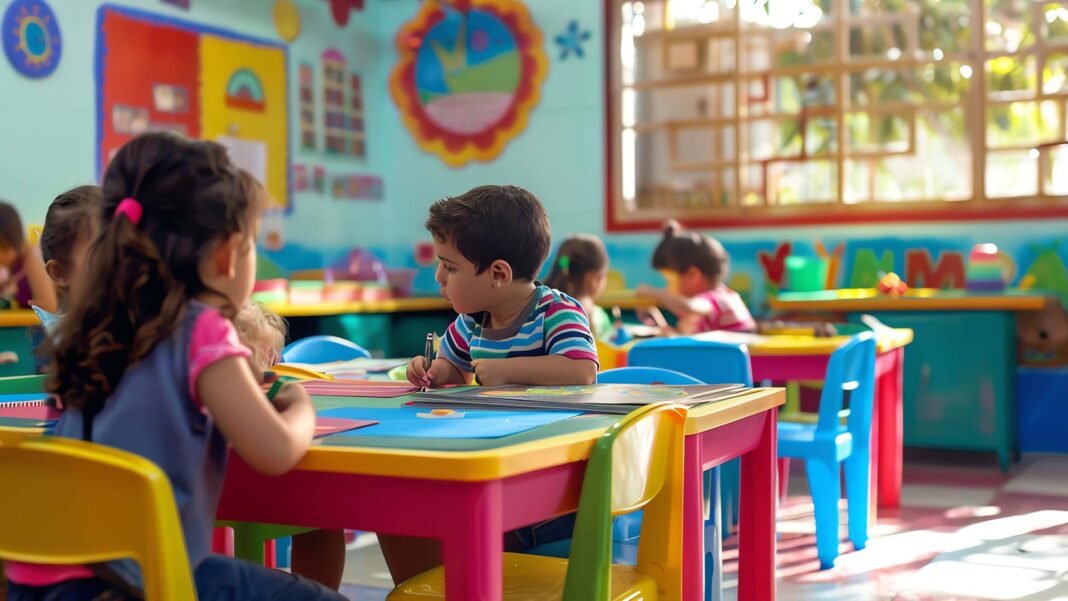
Walk into two different preschools and you’ll often see two very different philosophies at work: one where children move between activity stations, negotiating roles and solving small problems on their own, and another where they sit in rows practicing letters and numbers by repetition. Parents researching pre-school and daycare in Gurgaon are frequently told that “play-based” is simply the modern, trendier option. But the more useful question isn’t which approach is trendier, it’s what the research actually shows about how young children build lasting skills.
What Play-Based Learning Actually Looks Like
A common misconception is that play-based learning means unsupervised free time while teachers watch from the sidelines. In a well-run classroom, it’s the opposite: activities are carefully designed by educators to target specific developmental skills, counting through a pretend grocery store, building vocabulary through structured storytelling circles, practicing negotiation through shared building projects. The play is real, but it’s scaffolded with intention, teachers observe closely and step in to extend a child’s thinking at exactly the right moment, rather than leaving learning entirely to chance.
What the Research Shows About Early Academic Pressure
Early-childhood development research consistently points to structured play, not rote drilling, as the stronger foundation for later academic success, largely because of how it builds executive function: the ability to focus, switch between tasks, and regulate impulses. These are the skills that predict later academic performance more reliably than early letter or number recognition alone.
How Rote Memorization Affects Long-Term Retention
Rote memorization can produce fast, visible results, a four-year-old reciting numbers or letters looks impressive to a parent. But developmental researchers have found that information memorized without conceptual understanding tends not to transfer well; a child who has memorized counting to twenty may still struggle to understand that five objects and the numeral “5” represent the same quantity. Play-based approaches, by contrast, build that conceptual understanding more slowly but more durably, because the child is constructing the concept through direct, repeated experience rather than repeating a sound.
The Risk of Early Academic Burnout
Pushing formal academic instruction too early can also carry a motivational cost. Children asked to sit through repetitive, developmentally mismatched drills before they’re ready can develop early negative associations with structured learning itself, associations that are difficult to reverse later. Play-based programs, by keeping learning enjoyable and self-directed at this age, tend to protect a child’s intrinsic motivation for school for the years that matter most.
What Skills Play-Based Learning Actually Builds
Beyond academics, structured play is where young children build the skills that formal instruction can’t easily teach directly:
- Problem-solving, through open-ended building, sorting, and pretend-play scenarios
- Social-emotional regulation, through negotiating roles, turn-taking, and resolving small peer conflicts
- Language development, through storytelling, dramatic play, and peer conversation, often richer than adult-led instruction
- Early number sense, built through concrete, hands-on manipulation rather than abstract memorization
How This Looks Inside a Beansprouts Classroom
At Beansprouts, one of the best pre-school and daycare in Gurgaon options for parents prioritizing developmentally grounded teaching, structured play isn’t a break from learning, it is the learning. Activity stations are designed around specific developmental goals each week, and teachers are trained to extend a child’s thinking in the moment rather than simply supervise. You can see our approach to early learning to understand how each activity ties back to a specific skill.
Questions Parents Often Ask Before Choosing
Many parents comparing philosophies want reassurance that play-based learning isn’t a lesser or looser version of “real school.” It’s worth asking any preschool directly: how are activities designed to target specific skills, how is progress tracked without formal testing, and how does the program prepare children for the transition into structured schooling later. A program confident in its methodology should be able to answer all three clearly and specifically. If you’d like to see these answers in practice rather than on paper, you’re welcome to book a campus visit.
FAQs
Is play-based learning as effective as academic-focused preschool?
For children aged 2 to 6, most developmental research favors play-based approaches, particularly for building executive function and conceptual understanding, skills that predict later academic success more reliably than early rote instruction.
At what age should formal academics begin?
Most early-childhood specialists suggest formal, structured academic instruction is developmentally appropriate starting around age 6, aligned with the start of primary school, though foundational pre-literacy and pre-numeracy skills can be built through play well before that.
Will my child be behind if they don’t learn to read early?
Not typically. Reading readiness varies significantly between children, and early reading age is not a strong predictor of long-term reading ability. What matters more is a child’s exposure to rich language, storytelling, and vocabulary, all of which play-based classrooms build actively.
Closing Thought
Choosing play-based learning for your child isn’t choosing a trend over rigor, it’s choosing the approach that current developmental research most consistently supports for this age group. A good program can show you exactly how each activity builds a specific skill, which is the clearest sign that the play is doing real work.

